
N4D IN PARTNERSHIP WITH MINISTRY OF HEALTH GoE
LATEST NEWS
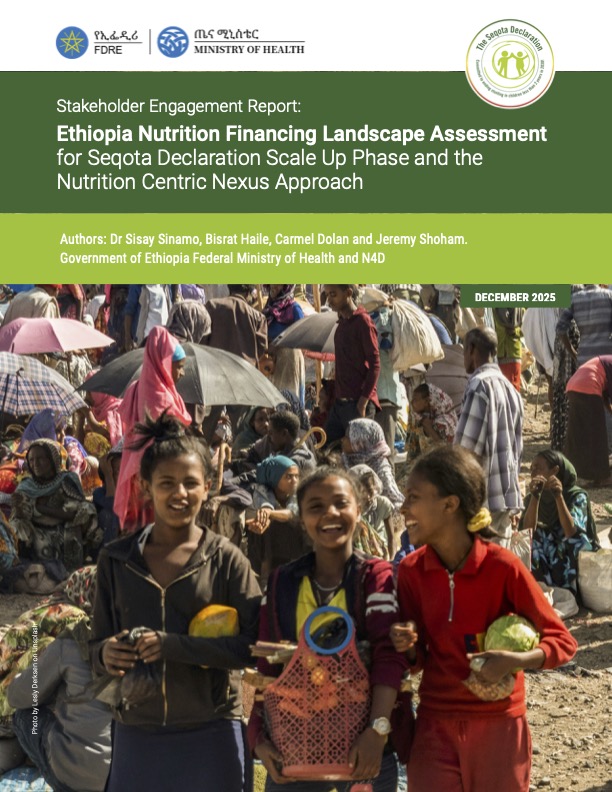
Financing Seqota Declaration Scale Up – Government of Ethiopia’s Ministry of Health, in partnership with N4D, release Stakeholder Engagement Report
1.0
Overview
Since 2019, there have been challenges to such progress due to multiple factors such as climate shocks, COVID-19 and conflict as well as changes in the national and global economic and political landscape. 2024 was viewed as an exceptional year in terms of compounded shocks or ‘poly crises’ affecting many already vulnerable people facing extreme hardship in accessing food and income due to drought and poor harvests. In response the 2024 Humanitarian Response Plan targeted approximately 10.4 million people for food aid and requested over US$3 billion in aid to respond for that year.
CHILDREN REQUIRE HUMANITARIAN ASSISTANCE
PEOPLE ARE INTERNALLY DISPLACED
PEOPLE NEED HUMANITARIAN ASSISTANCE
PEOPLE FACING FOOD & NUTRITION INSECURITY
%
CHILDREN AGED UNDER 5 YEARS ARE WASTED
%
CHILDREN AGED UNDER 5 YEARS SUFFER FROM MODERATE TO SEVERE STUNTING
Source:Ethiopia Humanitarian Needs Overview (February 2024)
N4D PARTNER: MINISTRY OF HEALTH, GoE
Ethiopia’s Ministry of Health (MoH) leads and guides the nation’s Food and Nutrition Policy and the National Nutrition Programme. Since malnutrition is a multisectoral problem, the MoH ensures the coordination of multiple nutrition-relevant ministries and partners to deliver the country’s vision.
Ethiopia has been a country member state of the global SUN Movement since 2010; the national SUN Focal Point, Dr. Sisay Sinamo Boltena is also the Senior Programme Manager for the Seqota Declaration Federal Programme Delivery Unit and based in the MoH. In 2015, the GoE made a high-level 15-year commitment to end stunting in children aged under two years by 2030. This commitment, known as the Seqota Declaration (SD), is operationalized through a multisectoral programme involving 14 different sector ministries, including Agriculture; Education; Finance; Health; Women and Social Affairs; Trade and Regional Integration, Industry, Planning and Development; Irrigation and Lowland Development; Transport and Logistics; Water and Energy; Urban and Infrastructure; and Innovation and Technology.

Dr. Sisay Sinamo Boltena
Senior Programme Manager, SD Federal Programme Delivery Unit
LISTEN TO DR. SISAY SINAMO BOLTENA DISCUSS GLOBAL AID FINANCING
Visit Ethiopia’s MoH website
Listen to the full N4D podcast with Dr Sisay Sinamo Boltena
Episode 9
1.1
Key characteristics of a NEXUS approach to nutrition
A HDPN approach to nutrition is guided by wider HDPN approaches such as the OECD DAC Recommendation on the Humanitarian-Development-Peace Nexus (see pdf download below).
N4D defines a HDPN approach for nutrition as:
“… [when] all humanitarian, development and peace actors draw on their comparative advantages and work in collaboration and coherence with each other, under national leadership, in order to achieve the collective outcome of sustained improvements in nutrition for all people. All stakeholders align with national and sub-national priorities as outlined in one overarching, national and multisectoral nutrition action plan.”
Key elements of a HDPN approach:
- Collective outcomes to sustainably reduce needs, risks and vulnerabilities by preventing, preparing and responding to malnutrition;
- Collaborative and coherent ways of working between humanitarian, development and peace-building actors;
- Drawing on respective comparative advantages; and
- Convergence of HDPN actions on the same at-risk populations.
Learn more
DAC Recommendation on the OECD Legal Instruments Humanitarian-Development-Peace Nexus (pdf)
Strengthening the Humanitarian-
Development Nexus for Nutrition in Protracted Crises (pdf)
Lessons learned and recommendations from the humanitarian-development nexus for nutrition (pdf)
1.2
The Ethiopian Context
Ethiopia has made significant progress in reducing the rates of malnutrition over the past two decades (see graph below), although high levels of child stunting, wasting, underweight and micronutrient deficiencies persist. By 2023, levels of child stunting and wasting remained high at 39 per cent and 11 per cent respectively, indicating the additional efforts needed to maintain the gains and the marked improvements attained in previous years.
The GoE’s flagship SD programme has shown very promising results in terms of stunting reduction (an annual reduction rate of 3 per cent) and the prevention of related deaths. Key success factors for the SD are the high-level leadership commitment, implementation of innovations, female empowerment approach, use of data for informed decision-making and sustained government and development partners’ financial commitments.
Other important policies and programmes in Ethiopia include the National Food and Nutrition Security Strategy, the Nutrition Sensitive Agriculture Strategy and the PSNP. All these efforts provide multisectoral nutrition guidance to improve the food and nutrition security of the Ethiopian population, as part of the national development agenda.
The Ethiopian Disaster Risk Management Commission (EDRMC) is responsible for preparing disaster prevention and preparedness policy, strategy and implementation. Under the EDRMC sits the well-established Ethiopia Emergency Nutrition Unit (ENCU), which leads and coordinates nutrition partners at federal, regional and district levels for a coherent, effective emergency nutrition preparedness and response to save lives and improve the nutritional status of vulnerable populations during emergencies. Both EDRMC and ENCU are key stakeholders in the development of the Nutrition Centric HDP Triple Nexus Operational Guide (OG) and Implementation Roadmap (IR).
Trends in nutritional status of children aged under 5 years in Ethiopia
Source: Ethiopian DHS for 2000, 2005, 2011, 2016 and 2019; Ethiopian Public Health Institute & Food & Nutrition Strategy baseline survey for 2023
1.3
Humanitarian, development and peace financing in Ethiopia
Ethiopia has experienced multiple complex and protracted crises for decades with billions spent in response. In the last 10 years, people in need of humanitarian assistance increased 10-fold, with two thirds of those being women and children. Although funding more than doubled between 2017 and 2023, actual funds received were below half of the required amount in six of the seven years. The 2023 Humanitarian Response Plan was funded at just 34 per cent.
Longer-term resilience building and multisectoral nutrition programmes such as the PSNP and SD have yielded significant improvements for the population including lowering rates of stunting and associated mortality. Ethiopia was the fourth highest recipient of official development assistance (ODA) globally, with US$5 billion received in 2022. The World Bank Group is the lead in developing multi-donor programmes to reduce transaction costs, aligning support with the country’s decentralized model and enhancing the predictability of aid. However, recent reductions in development investments have left such programmes as the PSNP facing acute funding shortfalls.
The MoH and EDRMC are now proposing a ground-shift in ways of working to maximise the collective impact of available resources for preventing malnutrition, through a Nexus approach that brings together humanitarian, development and peace building initiatives.
Source: States of Fragility
WORKING WITH GoE SUN FOCAL POINT
“Working alongside the GoE SUN Focal Point on the evolution of the Nutrition Centric Nexus Approach has been a highlight of N4D’s programme of work in 2024. There is no ‘one size fits all’ for tackling the complexity of responding to poly-crises, malnutrition and the institutional and financial silos that inhibit much-needed transformative change; but if any country can demonstrate proof of concept, it is Ethiopia. Thank you for letting us be a small part of this journey.”
From N4D Directors
2.0
Nexus approach in action
2.1
Support for scale-up of a national multisectoral nutrition programme

Breakout groups at NIPFN workshop in Addis Ababa facilitated by N4D, April 2024
N4D’s Directors have a long-standing engagement with different initiatives in Ethiopia spanning many decades and over numerous country visits. In 2023, N4D looked at the potential for greater nutrition sensitivity of the national PSNP, followed by a detailed evaluation of the Ethiopia National Information Platform for Food and Nutrition (NIPFN) in 2024.
In 2023, the Federal Ministry of Health nutrition coordination office asked N4D to support the development of its national Nutrition Centric HDP Triple Nexus (NC-HDPTN) Operational Guide and Implementation Roadmap.
Many of the documents outlined in these pages are available via Ethiopia’s Ministry of Health portal.
DEVELOPING the NC-HDPTN IN ETHIOPIA
GLOBAL INITIATIVES PRE 2016
RELIEF TO DEVELOPMENT CONTINUUM
- Relief to Development Continuum
- Disaster Risk Reduction
- Linking Relief, Rehabilitation and Development
- Resilience
GLOBAL INITIATIVES 2016 - 2022
WORLD HUMANITARIAN SUMMIT
- World Humanitarian Summit, resulting in ‘The Grand Bargain’: a pledge between humanitarian actors and donor to improve effectiveness and efficiency of humanitarian actions through “Nexus Approach”
- Recognition of significance of Peace pillar
2017
A NEW WAY OF WORKING
- The New Way of Working (a Nexus approach) calls on humanitarian and development actors to work towards ‘collective outcomes’ that reduce need, risk and vulnerability over multiple years.
2019
PUBLICATION OF OECD-DAC
- Publication of Organisation for Economic Co-operation and Development’s (OECD) Development Assistance Committee (OECD-DAC) criteria: 11 Nexus principles
2020
UN-DAC PARTNERSHIP FOR PEACE
ETHIOPIA'S NEXUS INITIATIVES 2023 - 2025
EMERGENCE OF ETHIOPIA’S NEXUS AMBITIONS
- HDP Nexus agenda identified by MoH as advocacy priority
- NC-HDPTN agenda identified as a priority
- Partners, resources and governance mechanisms mobilised
- Nexus included as advocacy agenda in the annual SUN Joint Annual Assessment report
2024
NC-HDPTN TAKES CENTRE STAGE
- Operational Guide and Implementation Roadmap developed
- Formal high-level launch
- On-going advocacy
2025
NC-HDPTN APPROACH – FROM THEORY TO PRACTICE & RESOURCE MOBILISATION FOR THE SEQOTA DECLARATION
- Context Assessment and Analysis Tools developed
- Testing the approach carried out in pilot SD woredas
- Training and sensitization activities held in selected regions
- Donor landscape resource mapping undertaken for the SD
2.2
N4D support in 2024
Though the concept of a nexus approach has been around in various guises since 2016, from a nutrition perspective, there wasn’t much in the way of existing frameworks, tools etc. to guide the NC-HDPTN approach in Ethiopia. N4D was able to share evolving Nexus learning from Niger and Yemen and generic principles from the global level.
Under the leadership of the MoH, Ethiopia’s SUN movement stakeholders made the NC-HDPTN a priority following the 2023 SUN Joint Annual Assessment. The GoE’s desire for this was to overcome the limitations of cyclical emergency nutrition response and to harness collective HDP resources and approaches. This in turn supports communities and families to be more resilient to shocks and to focus on the prevention of malnutrition, whilst maintaining treatment capabilities, and to visualise the route towards achieving a common goal around these priorities.
To kick-start the process, MoH presented the approach to Action Against Hunger (ACF) during a high-level engagement meeting in March 2023. ACF helped mobilise financial support and technical assistance to support the development of the Operational Guidance (OG) and Implementation Roadmap (IR), and this process was completed in over one year through a vibrant partnership between GoE and its partners.
Facilitation of technical coordination was through the newly-established Technical Working Group (TWG – see members’ list below) comprising stakeholders in government, UN and civil society organisations, academia and donors. N4D engaged with the TWG, providing technical and strategic assistance as required for the six phases of the NC-HDPTN (see diagram below).
The first three phases were completed one year later in July 2024.
Phase 1: As part of the first phase of implementation a situation analysis was conducted to explore the existing lessons, identify potential actors and stakeholders and identify essential ideas for the development of the NC-HDPTN OG and IR for Ethiopia.
Phases 2-3: During the second and third phase of the road map, the MoH in collaboration with its partners, finalised and officially approved the IR and OG.
Phase 4: The implementation phase is currently being initiated and this will involve the development of the Advocacy and Communication guide and M&E framework.
Technical Working Group - Members (click here)
| Name | Organization | Responsibility | |
| 1 | Hiwot Darsene | Ministry of Health | NCO-LEO |
| 2 | Dr. Sisay Sinamo | Ministry of Health | SD- Sr. Program Manager for Seqota |
| 3 | Yonatan Mamo | Ministry of Health | MS and SD desk head |
| 4 | Hailu Gebisa | ACF | HDP Concertium -COP |
| 5 | Asmamaw Eshete | ACF | Right2Grow Project Manager |
| 6 | Bisrat Haile | Ministry of Health | SD IA,Nexus Coordinator |
| 7 | Tofik Redi | Ministry of Health | Officer Gov. Nexus focal |
| 8 | Jeremy Shoham | N4D | Director |
| 9 | Carmel Dolan | N4D | Director |
| 10 |
Christopher Leather
|
N4D | Director |
| 11 | Girma Zewde | Catholic Relief Service | Program Manager, Peace Building |
| 12 | Daniel Bereded | Ministry of Peace | Expert |
| 13 | Kebede Mamo | Ministry of Health | Monitoring and Evaluation Advisor |
| 14 | Mulugeta Tegeng |
Ministry of Water and Energy
|
NTC member MOWE |
| 15 | Suraphel Fekadu | MoH | SD- Advocacy and Communication |
| 16 | Abebe Bimrew | SCI-ECSC SUN | Country Lead |
| 17 | Firaol Bekele | EDRMC | LEO |
| 18 | Rashid Abdulai | UNICEF | Nutrition Manager |
| 19 | Taye Girma | Ministry of Education | Desk Head |
| 20 | Lulseged Tolla | Concern Worldwide | Program Quality Director |
| 21 | Mengistu Gonsamo | Norwegian Church Aid | Peacebuilding Program Head |
| 22 | Sosena Melesa | WFP | Health and Nutrition Officer |
| 23 | Abriham Mengistu | SOS | Health and Nutrition Coordinator |
| 24 | Tariku Mekuria | SOS | Emergency coordinator |
| 25 | Asmelash Rezene | SOS | Nexus Project facilitator- Moyale |
| 26 | Misrak Admasu | R2G-THP | Nexus Project facilitator- Abeshge |
| 27 | Yihune Worku | MoWSA | NNTC member |
| 28 | Andualem Bekele | WHO | Project Officer |
| 29 | Daniel Tsegaye | MoH | M&E Advisor |
| 30 | Yared Adisu | MoA | HEAD, Research and capacity building |
What does a Nexus approach look like?
Phases of work in operationalizing the NC-HDPTN

N4D were also able to support the development of the NC-HDPTN Theory of Change (ToC) (see below, click image to enlarge) by drawing on learning from other ToC-related processes that we had supported.
NC-HDPTN Theory of Change

In April 2024, N4D visited Ethiopia to support the process of scoping donor and other stakeholder views on the NC-HDPTN. This also enabled a better understanding of the nutrition ecosystem, financing arrangements and the need to begin to understand how the NC-HDPTN and the SD could be linked operationally. Following the country visit, N4D co-developed with MoH colleagues a summary document of the OG and the IR for advocacy purposes and a generic concept note to support efforts to mobilise funding for the operationalisation of the approach through pilots in a small number of SD woredas.
N4D also co-authored with MoH and other colleagues a peer review published paper (see below) capturing the process.

DOWNLOAD KEY DOCUMENTS
2.3
N4D support in 2025
2025 has been a year focused on moving on from the theory (as set out in the OG/IR) to begin operationalising the NC-HDPTN approach in SD woredas that are exposed to different forms of fragility, and working with the MoH on donor resource mapping for the SD. This required technical work on some of the key tools for application at the sub-national level. Key among these were the Context Assessment and Needs Analysis Tools (available soon), which went through a detailed process for development by members of the TWG with N4D support.
Taking the NC-HDPTN OG/IR framework as their guide, two government partners secured financing from a variety of donors to begin piloting the NC-HDPTN approach and testing the tools. This work began in mid-2025 and MoH, as convenors of the NC-HDPTN, are supporting the pilots through engaging regional heads, sensitising key actors and supervising on-the-ground operationalization.
Piloting NC-HDPTN approach in vulnerable woredas
The early intention was to have four pilot regions running in parallel in 2025; however, resource constraints and other obstacles have meant that by the last quarter of 2025, two pilots were well underway in Oromia Region-Moyale woreda and Central Ethiopia-Abeshge woreda. Currently the Moyale woreda piloting is at project launching status and Abeshge woreda is at the stage where joint analysis of field data has been collected. These regions experience different types of vulnerabilities and crisis, and they have high levels of malnutrition. All are actively engaged in the SD programme through woreda-based costed annual plans for implementation into which the NC-HDPTN is integrated.
In October 2025, N4D attended (and financially supported) an MoH convened national TWG workshop to take stock of learning from the piloting and to review the gaps needed to be filled in order to finalise the tools as a nationally endorsed resource. This well-attended workshop involved the convening of four groups that each provided technical comments for finalizing the tools. The MoH team will utilize the lessons from two pilot woreda field assessments and oversee finalization and the TWG is expected to endorse the national tools in December 2025 (to follow). At this workshop, it was agreed that work should start on developing the communication and advocacy and monitoring and evaluation tools.
N4D, working alongside MoH colleagues, carried out a ‘light-touch’ mapping of donor resources for the SD and the NC-HDPTN in October 2025. This involved consultation with over 17 donors, private sector and foundation representatives to better understand the opportunities and constraints to more and better financing for nutrition in Ethiopia and to discuss progress with the SD, the financing needs to expand and achieve scale up by 2030 and to discuss the nexus approach.
Ethiopia Nutrition Financing Landscape Assement
Engaging with donors
A donor engagement report co-produced by MoH and N4D sets out the key findings and the short- and medium-term activities needed to drive up SD investment. The report will form the basis of a roundtable meeting to continue engaging with current and prospective donors.
The light-touch donor mapping is part of a larger analysis of the donor landscape being carried out in Niger and Yemen. Together, these country insights will inform the development of an advocacy paper in 2026, which will provide recommendations to donors investing resources in fragile and conflict-affected states (FCAS) contexts.
As well as the NC-HDPTN, there is a broader nexus approach being developed and piloted in Somali Region. This initiative is being supported by Team EU with UN being capacitated to lead the nexus approach and GIZ providing technical support. It aims to increase coherence across EU-financed programmes in fragile settings, including supporting populations who are displaced.
The financing landscape has changed as global aid contracts requiring greater national leadership and evidence
For the SD to reach scale, multiple and innovative partnerships are needed with strong government commitment and investment leading the way. Providing recent evidence of impact of the current SD interventions is vital to increased external investments as is a greater focus on targeted advocacy to increase awareness of the critical role nutrition plays in national development and stability.
N4D and FMoH recently conducted a light-touch review of the financing landscape in Ethiopia and concluded the following:
- Reduced budgets among many donors means they are more interested in programmes that address the underlying drivers of humanitarian need, to reduce instability and protect hard-won development gains through more sustainable actions including through the SD. Reducing the need for humanitarian response is also a growing priority in tandem with the need to reduce the large budgets allocated each year to short-term emergency response and in the case of nutrition, a greater focus on prevention while maintaining treatment capabilities.
- Government co-financing of the SD is the clearest signal of ownership and the strongest catalyst for tapping into more resources. The progress to date has been impressive with incremental federal and regional matched domestic funding arrangements as well as incremental sustained treasury budget allocations since the launching of the SD Innovation Phase.
- Considering the current global funding landscape challenges, there is a need for renewed advocacy efforts to showcase value for money, nutrition resilience outcomes and the impact of SD programming. This will support efforts to maximize and diversify resources for the SD Scale-up Phase by increased leveraging of existing matched funding models, using, new funding approaches such as pooled funds, engaging with donors to address constraints to direct budget support, and encouraging and enabling coordinated private-sector engagement.
- There are outstanding areas warranting further discussion to fully understand the potential for both greater and more flexible funding for nutrition and the nexus approach. A roundtable discussion of interested parties could usefully explore the different financing modalities with a view to collectively agreeing next steps and to following this up in the main strategic forum for donors and government, such as the Development Partners Group.
- It is also important for the government to build donor, private and foundation sector confidence through transparent government financial tracking systems and evidence of measurable results and impact. At the same time, donors need to report their nutrition investments to ensure accountability, increase trust, track nutrition allocations against the annual SD matching fund target for development partners and attract new investments.


3.0
Achievements & lessons learned
3.1
What has been achieved?
A great deal has been achieved in 2025 to better understand the financing landscape and to map out the strategic activities that will increase traditional and innovative resourcing for the SD Scale Up Phase. Added to this, the GoE has managed to galvanize partners to operationalise the NC-HDPTN approach in selected woredas, affording a unique opportunity to generate future evidence and learning.
In 2026, considerable effort will be placed on continuing to advance these important areas of work to help accelerate reductions in the levels of malnutrition in Ethiopia.
1: Better understanding of donor, private sector and foundation views on the current opportunities and constraints for nutrition investments in a challenging aid context
2: Increased awareness of the need to change the ways of working to enable joint humanitarian, development and peace actions to improve nutrition outcomes
3: Formation of a dedicated technical working group (TWG) to oversee the NC-HDPTN has strengthened stakeholder engagement and accountability
4: Awareness of the need to embed the NC-HDPTN in woreda-level SD planning and actions has increased in the regions being targeted for operational pilots
3.2
Lessons learned
Operationalising the NC-HDPTN is a learning journey
Being open about the wins and the obstacles inherent in operationalisation requires an active culture of learning, coupled with strong government coordination of the nexus-related initiatives in Ethiopia to actively share intelligence, resources and expertise. The TWG has proved to be such a forum and has experienced the following constraints:
- Limited engagement of peace pillar stakeholders
Little global, regional and national experience to draw on for the implementation of the nexus approach - Limited knowledge and capacity at sub-national level on integrating nexus programming into the existing SD coordination platforms
- Very varied levels of stakeholder understanding on nexus implementation can limit engagement
Whilst the nexus approach is not a separate project but a part of the SD, the development of new guidance, tools, sensitization and training to expand the pilots require relatively small amounts of financing. These can be hard to secure but are essential in building and sustaining momentum and for capturing learning on operationalisation.
Lessons learned: How to promote multi-stakeholder engagement across the NC-HDPTN and support more locally-led processes for scaling up multisectoral actions for nutrition
Cross learning between countries developing nutrition centric nexus thinking is hugely valuable
Presenting experiences from Yemen and Niger to the Ethiopia Technical Working Group helped in the early stages of the Nexus initiative. Specifically, N4D was able to distill elements of the Yemen Nexus Approach to benefit the evolution of the Ethiopia OG and IR. In 2026, N4D will facilitate further sharing of learning between Ethiopia, Yemen, Afghanistan and Niger as well as other countries, on progress with the SD and the integration of the NC-HDPTN into SD woreda-level plans.
Supporting countries in developing complex concepts requires an ongoing and sensitive approach
N4D worked behind the scenes, responding and advising in a timely and iterative fashion to numerous drafts of the OG and IR. This support was provided remotely through regular email exchanges and frequent video calls. The main approach we took was to be responsive to highly time sensitive feedback and technical guidance as the Ethiopia writing team produced different versions of the two main outputs against ambitious deadlines, which they duly achieved with excellent management of the process in-country.
Ensuring a highly inclusive process is crucial for developing a joint roadmap that represents all stakeholder views
The Technical Team at MoH oversaw a process of developing the OG and IR that included key line ministry representatives as well as the main humanitarian and development partners (see list of stakeholders in section 2.2). This served to ensure that the OG and IR included a consideration of complex coordination and governance arrangements, the financing modalities and the M&E needs. It also served to sustain the commitment of the working group members tasked with writing the drafts. The speed at which drafts were produced was hugely impressive.
Bringing other learning to bear on the approach strengthens collaboration
N4D, as an evaluator of the National Information Platform for Nutrition (NIPN) in Ethiopia, was able to advocate for an important data analysis and monitoring role for NIPN within the OG and IR. N4D actively supported the Nexus ToC based on the NIPN ToC approach, which very clearly separated outcomes from outputs and inputs. Conversely, N4D was also able to influence NIPN’s Phase Three ToC to include the Nexus Approach as it had worked across both projects.
Face-to-face meetings are key to increasing mutual understanding
N4D’s country visit in April 2024 clarified the centrality of the SD programme to operationalising the NC-HDPTN approach. Gauging potential donor support and potential obstacles was a key focus of stakeholder meetings and pointed the way in how to present the next phase of the NC-HDPTN approach to garner donor support. This ultimately resulted in the inclusion of the NC-HDPN approach as the 10th SD Innovation (the SD includes 10 innovations that drive forward the programme’s main goals and objectives). This important decision recognised that the nexus approach had to be fully integrated into multisectoral nutrition planning and programme implementation. This is especially key as the current FNS/SD (which predates the development of the NC-HDPN approach) does not currently incorporate the NC-HDPN approach.
Government processes and speed of securing funding for operationalizing phase must be taken into account
Working with senior government officials who manage multiple programmes, are part of numerous working groups and who cannot dictate speed of institutional change necessary for the nexus approach has meant that N4D has had to manage its own expectations on the pace of progress towards operationalizing the NC-HDPTN approach in Ethiopia.
MoH has also had to be opportunistic to move forward on operationalisation by capitalising on two INGO initiatives that were able to adopt important elements of the NC-HDPN approach in their needs assessment and proposal writing. These initiatives, although led by INGOs, have added to the experience of piloting the NC-HDPN approach.
Government leadership and partner engagement is enabling Ethiopia to generate valuable evidence
The know-how for how a nexus approach can be integrated into national multisectoral nutrition programmes will give unique insights into how the nutrition related needs of crisis vulnerable populations can be better met through convergence of actions across the HDP sectors.
Transitioning from the development of guidance, road maps and tools to operationalisation takes time
Senior government officials manage multiple programmes and initiatives and can’t dictate the pace of change necessary for the nexus approach. Moving forward with operationalization has been slower than hoped but opportunities amongst INGOs have been seized to begin sub-national pilots.
An understanding of community-felt needs is central to the nexus approach
The development of the Context Assessment and Needs Analysis tool has provided critical insights into the balance of humanitarian, development and peace building programming in relation to community-perceived needs. It also illustrates the extent to which these different pillars are or are not coordinated to better meet needs and harness existing community assets. The findings from the assessment and needs’ analysis surveys will illuminate how planning, programmatic shifts and coordination can be strengthened.
4.0
Next Steps
GoE has identified short- and medium-term activities to advance investments in the scale up of the SD, with the NC-HDPTN approach firmly integrated into national and sub-national planning processes. N4D will support activities working closely with MoH colleagues and their partners in 2026.
Key among these will be: the development of an investment case for the SD and NC-HDPTN; advocacy within government to increase domestic allocations for nutrition; establishing a taskforce to bring together donors, private sector and foundations to enhance collaboration around investments; and various advocacy- and evidence-related outputs to increase awareness and commitment to nutrition.
This page will continue to be updated with content and other supporting documents as the project progresses. We welcome any feedback and are always keen to engage in discussion.
All main images © Unicef. Other images N4D.